 Confucius
, one of the greatest
philosophers in human history, was born in 551 B.C.E. in the
Shandong Province of China. He was the creator of
Confucianism, the crowning jewel of philosophy, which still holds influence today in many east Asian countries. Even while he lived he had great influence all over China, but once Confucianism flourished, he became the day's equivalent of a superstar.
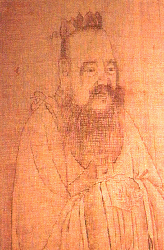
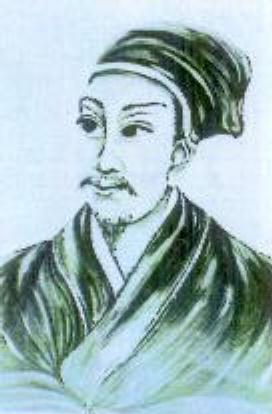
This Chinese man was a well-known leader in philosophy and he also made many wise phrases and theories about the law, life, and the government. In other words, about thoughts and theories that teach other people lessons about principles, or rules, about life and it also teaches you a moral ( sort of like the morals that are at the end of a fable). Confucius is famous for his philosophy because he made many wise sayings in ancient China that helped many people learn about nature, the world, and the human behavior. Additionally, he helped the government and the emperor by teaching them lessons on how the emperor should rule his kingdom successfully.
Confucius was born in a poor family in the year 551 B.C., and he was born in the state of Lu. His original name was K'ung Ch'iu. His father, commander of a district in Lu, died three years after Confucius was born, leaving the family in poverty; but Confucius nevertheless received a fine education.
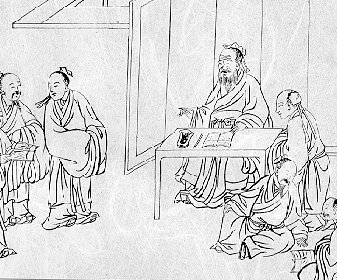
Living as he did in the second half of the Zhou (Chou) dynasty (1027?-256 BC), when feudalism degenerated in China and intrigue and vice were rampant, Confucius deplored the contemporary disorder and lack of moral standards. He came to believe that the only remedy was to convert people once more to the principles and precepts of the sages of antiquity. He therefore lectured to his pupils on the ancient classics.
Confucius taught in his school for many years. His theories and principles were spread throughout China by his disciples, and soon many people learned from his wise sayings.
One of his rules said," If you governed your province well and treat your people kindly, you kingdom shall not lose any war. If you govern selfishly to your people, you kingdom will not only lose a war, but your people will break away from your kingdom." He had also said a wise phrase called the golden rule that is still being used as a rule today. It said,"A man should practice what he preaches, but a man should also preach what he practices." Confucius said,"Remember this, my child. An oppressive government is fiercer and more feared than a tiger."
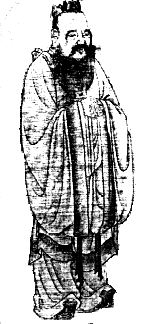
He taught the great value of the power of example. Rulers, he said, can be great only if they themselves lead exemplary lives, and were they willing to be guided by moral principles, their states would inevitably become prosperous and happy.
Confucius had, however, no opportunity to put his theories to a public test until, at the age of 52, he was appointed magistrate of Chung-tu, and the next year minister of crime of the state of Lu. His administration was successful; reforms were introduced, justice was fairly dispensed, and crime was almost eliminated. So powerful did Lu become that the ruler of a neighboring state maneuvered to secure the minister's dismissal. Confucius left his office in 496 BC, traveling about and teaching, vainly hoping that some other prince would allow him to undertake measures of reform. In 484 BC, after a fruitless search for an ideal ruler, he returned for the last time to Lu.
Confucius was then abandoned from his province and he wandered about China for 13 years. When Confucius was 69 years old, he returned to Lu, his home state, and he died there 3 years after settling in Lu - 479 BC.
After Confucius died, he was buried in a grave in the city of Ch'uFu, Shandong. Today the site of his final resting place is the beautiful K'ung Forest.
Yet, when the philosopher died, many people honored all of Confucius' work by building temples in every city in China to honor Confucius. Since Confucius' teachings and philosophy was so advanced, it was the education for China for 2,000 years.
Confucius himself had a simple moral and political teaching: to love others; to honor one's parents; to do what is right instead of what is of advantage; to practice "reciprocity," i.e. "don't do to others what you would not want yourself"; to rule by moral example (dé) instead of by force and violence; and so forth. Confucius thought that a ruler who had to resort to force had already failed as a ruler. "Your job is to govern, not to kill" Confucius did not put into writing the principles of his philosophy; these were handed down only through his disciples.
Confucius is one of the most influencial characters in Asian history and he will be recognized for years to come.


